

How To Clean Up The Background In Photoshop
Photoshop offers many unlike techniques to remove an unwanted groundwork from an paradigm. For unproblematic backgrounds, using the standard Magic Wand tool to select and delete the background may well be more than than adequate.
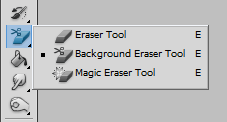
For more than complicated backgrounds, you might use the Background Eraser tool. This tool samples the color at the center of the brush and then deletes pixels of a like color equally you "paint." It feels like painting with acid. Allow me show you how it works.
1. Open your paradigm
—
Beginning by grabbing an image that you desire to remove the background from. I'll be using this image every bit it features areas that range from easy removal through to more than challenging spots.

2. Select Groundwork Eraser
—
Select the Background Eraser tool from the Photoshop toolbox. It may be hidden beneath the Eraser tool. If information technology is, simply click and hold the Eraser tool to reveal information technology.
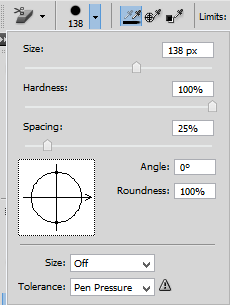
On the tool options bar at the top of the screen select a round, hard brush. The well-nigh appropriate brush size will vary depending on the image you lot're working on. Use the square bracket key ([ or ]) for quickly scaling your castor size.
Next, on the tool options bar, gear up the Sampling to Continuous, the Limits to Discover Edges and a Tolerance of somewhere between xx-25% is a skillful starting place.
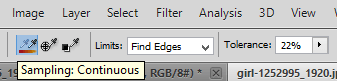
Note: A low tolerance limits your eraser to areas that are very like to your sampled color. A higher tolerance expands the range of colors your eraser will select.
iv. Brainstorm erasing
—
Bring your castor over your groundwork and begin to erase. You should meet a brush-sized circumvolve with pocket-sized crosshairs in the center. The crosshairs show the "hotspot" and delete that color wherever it appears inside the brush area. It besides performs smart color extraction at the edges of any foreground objects to remove 'color halos' that might otherwise exist visible if the foreground object is overlayed onto another background.
Notation: For the example image, I actually used a rather high Tolerance than the twenty-25% recommended above due to the wide range of blues backside this subject.

When erasing, zoom upward your piece of work surface area and try to keep the crosshairs from overlapping on the edge of your foreground. Information technology'south likely that you will demand to reduce the size of the brush in some places to ensure that you lot don't accidentally erase office of your foreground subject.
v. Choosing constructive limit and sampling settings
—
Fifty-fifty though I take used a smaller brush to piece of work effectually the hair and cervix area, the Background Eraser has nevertheless managed to gouge a few chunks out of the hair and shirt.

For foreground image areas that share colors with the background (similar this one), you may need to adjust the Sampling andLimits. In this motion picture, I switched over to the Sampling: Once option, prepare my Limits to Discontinguous and set my Toleranceto xxx%.

The Sampling: One time option samples the color under the crosshair simply the moment yous click and information technology doesn't resample as you movement your brush along. The Discontiguous Limit choice allows you lot to erase all pixels that match the sampled color that you're erasing. This allowed me to go far between the hair strands without erasing them.
At that place'south a expert take a chance the Background Removal Tool may be all you demand to complete your task.
Merely if not, read on.

While removing the background on our instance prototype is more often than not straight-frontward due to the fairly solid background, there are inevitably areas of our foreground field of study that get wrongly erased as we piece of work close to foreground's edges.

In our case, the foreground and groundwork share like colors due to the lighting. This will exist easiest to repair using Photoshop'due south Pen tool. I but have a modest section I need to bear upon upward, so I'll apply the Pen to create a clean selection and delete the unwanted groundwork.


Conclusion
—
If yous are working with a basic image with ample visual contrast between the subject and background, you can most likely get abroad with using simply the Background Eraser Tool.
More complex images will likely require a mix of tools, samplings, and tolerances along with occasional manual impact-ups. In that location will be times when in that location is no visual difference between the foreground and background. We have to manually impose that distinction.
And don't forget that if you are saving your paradigm without adding a new background, you need to relieve information technology every bit a PNG to maintain the transparency.
This commodity was originally written for Sitepoint by Jennifer Farley and Gabrielle Gosha.

Source: https://99designs.com/blog/design-tutorials/how-to-quickly-remove-a-background-in-photoshop/
Posted by: goeringclady1962.blogspot.com
0 Response to "How To Clean Up The Background In Photoshop"
Post a Comment